
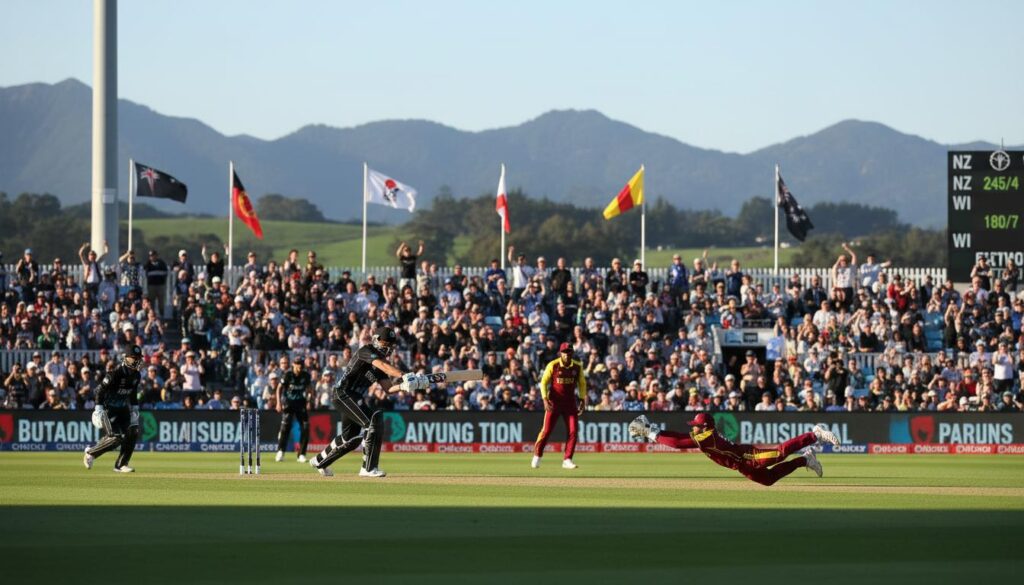
Type “nz vs wi” into a search bar and you’ll land in the heart of one of cricket’s most watchable matchups: New Zealand vs West Indies. For Canadian fans—newcomers, long-time followers, and everyone who just wants something riveting to watch after hockey hours—this fixture delivers style contrasts, late-night drama, and a steady stream of talking points. This guide walks you through the rivalry, what to expect tactically, how to watch in Canada, time-zone tips, betting regulations, travel notes if you’re thinking of seeing a match live, and practical ways to get more from every ball.
Why “NZ vs WI” Is Worth Your Time (Especially in Canada)
New Zealand and the West Indies play cricket in ways that feel almost designed to collide. New Zealand’s method—planning, discipline, and small tactical wins—often runs headlong into the West Indies’ power, flair, and the ability to bend a game in a couple of overs. When they meet, you tend to get matches that swing on a moment: a yorker at the death, a one-handed boundary save, a batter who refuses to blink during a collapse.
For Canadians, there are practical reasons to tune in. Live start times often land in off-peak hours, which means you can catch key phases with a morning coffee in Vancouver or a late evening in Toronto without nuking your day. Coverage is increasingly easy to find. And because Canada is a growing cricket nation—with junior leagues sprouting in the GTA and a professional T20 league hosted in Brampton—watching top-tier teams like New Zealand and the West Indies is more than entertainment. It’s a front-row class in how modern cricket actually works.
We’ll cover the rivalry stories, format differences (T20I, ODI, Tests), Canadian viewing options for nz vs wi, real-world tactics, and what the conditions in Auckland or Antigua mean for the way a match unfolds.
Formats 101: What an NZ vs WI Match Looks Like in T20Is, ODIs, and Tests
If you’re coming from hockey or basketball, think of cricket formats as leagues with different game lengths and pacing. NZ vs WI plays out across three official formats, and each one asks different questions of the players—and your attention span.
T20 Internationals (T20Is): The two-hour thriller
T20Is are 20 overs per side. You’ll get a roughly three-hour event including breaks, packed with intent from the first ball. West Indies often thrive here because of their power hitters, while New Zealand’s edge comes from efficiency in powerplay bowling, sharp field placements, and batting depth. You’re likely to see match-ups specifically crafted for twenty overs—left-arm spinners vs right-hand sluggers, pace off the ball, funky fields designed to tempt a mishit. If your goal is “NZ vs WI live tonight” with fireworks and a definitive result fast, T20Is are your format.
One-Day Internationals (ODIs): The chess match with speed limits
ODIs are 50 overs a side and usually run seven to eight hours including the innings break. There’s more room for narratives: rebuilding from 30/3, launching at the death, and mid-innings slow-burn pressure. New Zealand typically shine with smart middle-over bowling, while the West Indies push hard at either end, hunting for momentum. ODI contests tend to reward versatility—players who can anchor then accelerate, or seamers who switch plans as the ball ages.
Test Matches: Five days, and every session counts
Tests stretch to five days, two innings each. It’s cricket without the stopwatch, where patience and technique rise in value. Historically, New Zealand’s red-ball discipline and swing/seam resources at home have produced strong results against touring sides, including the West Indies. In the Caribbean, pace, bounce, and reverse swing can bend the story back the other way. You won’t see Tests as frequently on North American-friendly time slots, but the on-demand highlights and daily summaries make following the ebb and flow realistic even with a Canadian workweek.
Rivalry Storylines, Past and Present
Rivalries in cricket are built from snapshots: a runaway knock, a hat-trick that hushes a crowd, a captain who gambles right. NZ vs WI has more than a few such moments, and understanding them helps you read the next chapter as it’s written.
A modern touchstone arrived at the 2015 ODI World Cup when New Zealand’s Martin Guptill produced a historic 237* against the West Indies in the quarterfinal at Wellington—one of those innings that break tournaments wide open. On the flip side, in the 2024 T20 World Cup, the West Indies clipped New Zealand in a critical group match in the Caribbean, underlining how much T20Is hinge on small phases: a strangling over of spin, a cameo that upgrades a par score, or a direct hit that prevents a set batter from going berserk.
Between those bookends lies a lot of competitive cricket: New Zealand touring the Caribbean, the West Indies in windy Wellington or Christchurch, and bilateral T20I series that often go to a decider. The short version: the rivalry is real, recent form matters, and venue conditions often change the identity of the favorite.
How They Play: Style, Strengths, and the Matchups That Decide NZ vs WI
When you watch nz vs wi with a tactical lens, you start seeing patterns. Here’s a concise way to track what’s unfolding in front of you.
New Zealand’s blueprint
New Zealand sides are generally built around control. That can mean swing bowling early, spinners who hit repeatable lengths, and batters who rotate strike against spin rather than freeze. In T20Is, they love bowlers who can change pace and line without bleeding boundaries. In ODIs and Tests, they bank on outlasting the other team’s mistakes.
The batting style: either a stable anchor (think classic top-order craft) alongside one or two powerful middle-order players who can flip a gear. In T20s, players like Glenn Phillips or Daryl Mitchell embody that change-up: clearing midwicket one ball, then punching singles the next. With the ball, a New Zealand attack might feature a left-arm angle to mess with right-handers, or a tall quick who extracts bounce even on slow pitches.
West Indies’ game plan
The modern West Indies white-ball identity leans into athleticism and power. They don’t just clear the rope—they threaten the rope from ball one. This is especially visible in T20Is, where a Nicholas Pooran cameo or an Andre Russell surge can wreck carefully-constructed plans. Their spinner pool often provides wicket-taking deliveries rather than just containment, and their quicks—when healthy and firing—bring heavy lengths and steep bounce.
With the bat, watch for intent in the first six overs of a T20I: if they get a flyer, it’s a different chase. In ODIs, they’ve increasingly tried to stabilize the middle overs to avoid the feast-or-famine trap. Fielding can be spectacular; a boundary save here, a run-out there, and a middling total becomes a winning one.
Key tactical matchups you’ll see again and again
- Left-arm spin vs right-hand power: New Zealand will often test right-hand West Indies big-hitters with a left-arm orthodox spinner (think of the Mitchell Santner type) tight into the stumps, aiming for mishits to long-on/long-off.
- Short, heavy pace vs anchors: The West Indies, especially at home, don’t mind peppering top orders with chest-high questions. On slower decks, that turns into cutters and cross-seam deliveries that hold in the pitch.
- Death overs: This is where nz vs wi matches flip the most. Can New Zealand nail yorkers under pressure? Can the West Indies avoid dot-ball build-up at the wrong time? Two good overs at the death can add or deny 20–30 runs—often the difference.
- Wind and boundary geometry: At grounds like Wellington’s Sky Stadium or Auckland’s Eden Park (short straight boundaries), captains use the wind and rope dimensions to dictate which big shots are “on.” You’ll see fields stacked to the longer side, and bowlers angling lines toward it.
Conditions: Why Auckland, Wellington, Bridgetown, and Port of Spain Don’t Play the Same Game
One reason nz vs wi never gets stale is that the surface and climate treat the same players differently in different hemispheres.
New Zealand venues and what they do to a match
New Zealand grounds can be windy, and that wind matters. In Wellington, cross-breezes turn “safe” lofted shots into catching practice. In Christchurch (Hagley Oval), there’s often live grass early that brings seamers into the game, especially Tests and early-season ODIs. Auckland’s Eden Park has shorter straight boundaries that reward straight hitting but also lure batters into misjudgment. Seddon Park (Hamilton) often flirts with spin-friendly behavior later in white-ball matches, especially when the pitch tires.
The net effect: New Zealand at home tend to enjoy first-10-over dominance with the ball if there’s cloud or grass, while batting line-ups plan for smart risk selection—choose the side of the ground that helps you, keep the ball downwind, and attack the match-ups rather than swinging blindly.
West Indies and Caribbean pitches: speed, grip, and the night factor
“The West Indies” is many nations, many pitches. Barbados (Kensington Oval) often offers true pace and bounce; Trinidad can be slower, rewarding bowlers who take pace off; Guyana’s Providence has been kind to spinners; St. Lucia and St. Kitts can change character with preparation and weather. Dew sometimes slides in at night in limited-overs games, making the ball skid on and smoothing chasing conditions—though that’s not universal.
Power-hitting thrives when the ball comes on, but don’t sleep on cutters and back-of-the-hand slower balls that grip. If a deck is two-paced, 160 in a T20 can play like 185. Watch how quickly captains clock the surface character. That first over of cutters that die on a length? It’s a tell.
Weather delays and DLS in plain English
Rain happens—more often in New Zealand’s shoulder seasons, and unpredictably in the Caribbean. In limited-overs cricket, the Duckworth–Lewis–Stern (DLS) method resets targets when overs are lost to weather. For viewers, the key is this: if rain shortens the chase, the target is revised to reflect resources (overs and wickets). It can feel counterintuitive—“Why did 145 suddenly become 118 off 14?”—but DLS is mathematically calibrated to the usual scoring patterns. If you’re watching nz vs wi live in Canada and rain hits, broadcasters will show the DLS par score graphic; that’s your reference for whether the batting side is ahead or behind.
What the Numbers Say (Without Getting Lost in Them)
You don’t need a spreadsheet to enjoy nz vs wi, but a few metrics make your viewing sharper:
- Powerplay scoring rate (overs 1–6 in T20Is; 1–10 in ODIs): West Indies often try to win here. If New Zealand hold them to a run-a-ball with one wicket down, advantage New Zealand. If West Indies clear 50–60 in a T20 with minimal damage, watch out.
- Dot-ball percentage: T20s turn on pressure. Three quiet overs create a mistake. New Zealand target this with accurate spin and cross-seam variations.
- Death overs economy (overs 16–20): Whoever blinks here, loses. The best death spells are a mosaic: yorker, slower bouncer, wide yorker, repeat. If a bowler can’t hit those lengths, the rope gets a workout.
- Boundary vs singles ratio: Teams that mix boundaries with frequent strike rotation avoid stagnation. The West Indies have consciously added more ones and twos to complement power; New Zealand’s batters are drilled to find gaps even when boundary strokes are risky.
As for head-to-head across eras, New Zealand have traditionally been stronger in Tests and competitive in ODIs; T20Is feel more like knife-fights, with short bursts deciding outcomes. Exact tallies evolve every series; check a reputable stats database (ICC or long-standing cricket outlets) if you want the latest ledger before a match.
How to Watch NZ vs WI in Canada: TV, Streaming, and Replays
Rights packages shift over time, but for most recent ICC events in North America, Willow TV has been the key broadcast partner, including in Canada. Depending on the specific series or tournament, Hotstar Canada has also carried some ICC cricket. Availability varies, so confirm for the exact tour or event you’re targeting.
Here’s a practical way to get set up for nz vs wi in Canada:
- Check Willow TV first. In Canada, it’s commonly available as a streaming subscription and sometimes as an add-on via major cable/satellite providers. Plans and pricing can change—verify on Willow’s official site or your TV provider’s channel store.
- For certain tournaments, Hotstar Canada may carry live matches and on-demand highlights. If you already subscribe, search within the app for “New Zealand vs West Indies” or “NZ vs WI live.”
- Some series not under ICC global events may be on other partners. Cross-check the relevant cricket board announcements (New Zealand Cricket, Cricket West Indies) and Canadian provider listings the week a series starts.
- Cricket-friendly pubs in major cities often screen big games. In the GTA, South Asian or Caribbean sports bars are your best bet; in Vancouver, check pubs near Commercial Drive or Surrey hubs; in Calgary and Edmonton, South Asian eateries that host live sports occasionally show marquee matches—call ahead.
Tip: If a match is overnight in your province, set a PVR if you’re watching on TV, or plan to use the streaming service’s replay function. Many platforms offer full replays and condensed highlights, which is perfect for a 6:00 a.m. coffee in Ottawa or a lunch break in Halifax.
Time-zone planner for NZ vs WI from Canada
West Indies home matches typically run in Atlantic Standard Time (UTC−4). New Zealand home matches run in NZT (UTC+12, or +13 with daylight saving). Here’s a quick conversion cheat sheet for common start times. Always verify exact match listings, since start times vary by venue and format.
| Match starts in | Local start | Toronto (ET) | Vancouver (PT) | Calgary (MT) | Winnipeg (CT) | Halifax (AT) | St. John’s (NT) |
|---|---|---|---|---|---|---|---|
| Trinidad (UTC−4) | 7:30 pm | 7:30 pm | 4:30 pm | 5:30 pm | 6:30 pm | 8:30 pm | 9:00 pm |
| Barbados (UTC−4) | 10:00 am | 10:00 am | 7:00 am | 8:00 am | 9:00 am | 11:00 am | 11:30 am |
| Auckland (UTC+12) | 7:30 pm | 3:30 am (same day) | 12:30 am | 1:30 am | 2:30 am | 4:30 am | 5:00 am |
| Wellington (UTC+12) | 2:00 pm | 10:00 pm (previous day) | 7:00 pm (previous day) | 8:00 pm (previous day) | 9:00 pm (previous day) | 11:00 pm (previous day) | 11:30 pm (previous day) |
Remember daylight saving: many Caribbean nations don’t shift clocks; Canadian provinces do. New Zealand switches between NZST and NZDT. If a Google search says “tomorrow” but your TV guide says “tonight,” you’re probably straddling the date line.
If You’re New to Cricket: A Quick Primer Using NZ vs WI Examples
Watching your first nz vs wi can feel like opening a book in the middle. Here’s a compact glossary to keep the plot straight:
- Over: Six legal balls. Limited-overs cricket counts down overs like a shot clock.
- Powerplay: Early overs with strict fielding limits (fewer fielders allowed outside the circle). Expect attacking batting and aggressive seam bowling.
- Strike rotation: Batters swapping singles to avoid dot balls. New Zealand prize this; the West Indies now balance strike rotation with boundary hitting.
- Yorker: A ball aimed at the batter’s toes. Crucial in the death overs. Miss by a few inches and it becomes a full toss (easier to hit).
- LBW: Leg Before Wicket. If the ball would have hit the stumps but the batter’s pad blocked it (with caveats), the batter can be out. Umpire’s Call and DRS (video reviews) can add drama.
- Death overs: Final overs of a limited-overs innings. Small errors here are magnified. nz vs wi games are often decided in this phase.
In Tests, think in sessions (morning, afternoon, evening). The ball moves more when it’s newer. Pitches evolve—quicker on day one, abrasive by day four, spinning more on day five. Patience is a weapon. That’s one reason New Zealand’s structure-first approach has served them well at home, while the West Indies’ resurgence in red-ball cricket tends to orbit around fast bowlers who can keep creating chances even when batters dig in.
Players to Watch: Skill Sets That Shape NZ vs WI
Rosters change by series, format, and fitness. Use this as a skills-based map rather than a permanent roll call. If you’re scanning a lineup card an hour before toss, look for these archetypes and the names that carry them.
New Zealand
- The anchor with gears: New Zealand often field a calm top-order player who reads conditions early, then lifts tempo. Against the West Indies, this anchor is vital to blunt the opening burst and prevent a collapse.
- Middle-order bruiser/finisher: A batter who can hit seamers off a hard length and spinners against the turn. One cameo here turns 145 into 165 in a T20I.
- Left-arm spin metronome: Not flashy, very effective. This bowler ties down right-handers, forces mishits, and feeds boundary riders.
- New-ball swing + hit-the-deck pace: The pairing keeps batters guessing—one drags edges forward, the other climbs into the chest.
- Gun fielder: Expect boundary saves, slides into the rope, and a flat-arm throw to the keeper. New Zealand’s ground fielding is consistently tight.
West Indies
- Explosive left-handers: The West Indies’ lefties love deep midwicket and long-on. If they settle, field placements scramble and bowlers get conservative.
- All-rounders with lift: The right all-rounder adds 20 off 8 at the end and sneaks two tidy overs. It’s balance that transforms team selection.
- Fast bowlers who hit hard lengths: On Caribbean tracks that bounce, those chest-high questions create catches at deep square leg and fine leg. In New Zealand, that length can still work if the wind helps miss-hits carry to the long side.
- Wrist-spin or mystery spin: One over that rips past the outside edge often becomes three maidens across the innings, because batters stop sweeping and lose singles.
- X-factor fielding: A diving stop in the ring or a no-angle throw from the rope shifts momentum in a way raw stats never fully capture.
Reading a Live NZ vs WI Match Like a Pro
Want to look smart in a WhatsApp group chat at 1:00 a.m. Toronto time? Track these questions as you watch:
- Is the ball holding in the surface? If cutters work, teams that change pace intelligently will boss the middle overs.
- What side is longer with the wind? Batters should target the short or downwind side. If they keep picking out the long side, the bowling plan is winning.
- Has either team “spent” its matchups early? If a side burns through its left-arm spinner before the main right-hand power-hitter arrives, the batting side might be able to cash in later.
- Are singles available? If no, expect panic shots. If yes, the side that keeps the board moving usually wins close ones.
- What’s par today? Don’t assume a number from another venue. A sticky 150 can beat a free-scoring 175 if the deck is two-paced.
Fantasy, Props, and Betting in Canada: The Rules and the Risks
Sports betting on cricket—including nz vs wi—became clearer in Canada after changes to federal law in 2021 allowed single-event wagering. The details are provincial:
- Ontario runs an open, regulated market overseen by the Alcohol and Gaming Commission of Ontario (AGCO) and iGaming Ontario (iGO). Licensed private sportsbooks operate here alongside OLG’s PROLINE+.
- British Columbia, Manitoba, and Saskatchewan offer wagering through PlayNow (BCLC runs PlayNow in BC and MB; SIGA partners in SK). Alberta has PlayAlberta. Québec has Mise‑o‑jeu+. Atlantic Canada uses ALC’s platforms for the region.
Practical advice for Canadians thinking about nz vs wi bets or fantasy:
- Use provincially regulated sites in your province. They publish clear house rules, including how DLS affects settled bets and what happens if overs are reduced.
- Cricket props can be tricky. “Top batter” is volatile in T20Is; one edge or a run-out wrecks sound logic. “Bowler over/under economy” or “team boundaries” can align better with pitch reads.
- Bankroll management matters. Cricket has variance baked in. Set limits, avoid chasing losses, and treat it as entertainment.
If you’re in Ontario, check that your operator is AGCO-licensed. Elsewhere, stick to your provincial crown corporation’s official site or app. And if it stops being fun, use the responsible gambling tools (deposit limits, time-outs) or reach out to provincial helplines posted on those platforms.
For Canadian Youth Players and Coaches: What NZ vs WI Teaches
Canada’s grassroots game is growing fast. Use nz vs wi as film study for weekend practice:
- Batting against spin: Watch how batters use the crease—deep in the crease to cut, or a stride down to smother. Set a cone drill with target gaps and practice soft hands into them.
- Power with shape: West Indies batters stay still at impact even when swinging hard. In nets, emphasize a stable base first; distance comes later.
- Pace-off bowling: Copy New Zealand’s habit of changing pace without changing arm speed. Shadow-bowl slower balls until your body language is identical to your stock ball.
- Fielding standards: New Zealand’s ground fielding is a masterclass in basics—angles, two hands, quick releases. Build a 15-minute circuit (pick-up/throw to stump, one-bounce over the stumps, boundary tap-back) every session.
Clubs across the GTA, Calgary, Edmonton, Vancouver, Winnipeg, and Montreal now run youth programs through provincial associations under Cricket Canada. Check your provincial body for the closest junior league. Game IQ is free—watching smart is part of training.
Travel Notes for Canadians: Seeing NZ vs WI in Person
Dreaming of a summer series in the Caribbean or a December tour in New Zealand? A bit of homework goes a long way.
Entry requirements
- New Zealand: Canadian passport holders typically need an NZeTA (New Zealand Electronic Travel Authority) and pay the International Visitor Conservation and Tourism Levy (IVL) for short visits. Apply online well before departure; approvals are often swift but don’t risk last-minute delays.
- Caribbean hosts: “The West Indies” is a cricket team representing multiple countries. Entry rules differ by island (e.g., Barbados, Trinidad and Tobago, Jamaica, St. Lucia, Guyana). Canadians often have visa-free short stays, but always verify with each country’s official government site before booking.
Ballpark travel budgets (very rough, in CAD, subject to change)
- Caribbean series: Return flights from Toronto or Montreal can range from $600–$1,400 depending on island and season. Mid-range hotels often $120–$250/night. Match tickets vary by format and stand; T20I tickets typically fall in the accessible range, with premium hospitality higher.
- New Zealand tour: Return flights usually $1,700–$2,500 from major Canadian hubs, more at peak holiday periods. Accommodation $150–$300/night for comfortable mid-range stays. Internal travel between Auckland, Wellington, and Christchurch is easy via domestic flights or scenic rail/bus.
Local logistics
- Driving: New Zealand drives on the left. If that’s new to you, consider city transit or short-haul flights between venues. Many Caribbean islands also drive on the left—check your host country.
- Connectivity: Buy a local SIM on arrival for data-heavy live score apps. Stadium Wi‑Fi can be crowded on match days.
- Sun and hydration: Caribbean noon sun is no joke. Sunscreen and a hat go from “nice to have” to “non-negotiable.” New Zealand’s UV index also spikes—pack accordingly.
Always buy tickets from official channels (cricket boards or authorized partners) to avoid counterfeits. If a deal looks too good to be true, it usually is.
Gear, Kits, and Merch in Canada
You’ll find basic cricket gear at specialty stores in the GTA (Brampton, Mississauga), Surrey in Metro Vancouver, and Calgary/Edmonton niche shops. Online Canadian retailers stock bats, balls, protective gear, and national team jerseys—including New Zealand and West Indies kits in season. For official replica shirts, check each board’s official store or major global sports retailers that ship to Canada; confirm sizing charts, as international fits can run smaller.
Hosting a Canadian Watch Party for NZ vs WI
Cricket and community pair well. A few ideas that travel nicely between Kingston, ON and Kingston, Jamaica:
- Menu: Jerk chicken sliders, patties, fried plantain, and coleslaw on one tray; New Zealand-inspired pavlova or hokey pokey ice cream on the other. For a lighter option, kiwi fruit skewers and Caribbean-style grilled corn.
- Start-time math: Use the time-zone table to avoid dragging guests over early. If it’s a 3:30 a.m. start from Auckland, consider a breakfast watch with coffee and pastries.
- Neighbour-friendly: Some Canadian municipalities have quiet hours. If it’s a midnight West Indies start, keep celebrations indoors. A wicket at 1:00 a.m. still counts if you high-five silently.
- Tech: Test your stream in advance. If you’re casting from a phone, plug into Ethernet or sit near the router. Announce a Wi‑Fi password for guests to avoid network bottlenecks.
Common Mistakes Fans Make Watching NZ vs WI (and How to Avoid Them)
- Treating every pitch the same: A 170 target isn’t “par” everywhere. Calibrate to the deck after two overs, not your memory of a different venue.
- Ignoring the wind: In New Zealand especially, wind dictates safe vs risky hitting zones.
- Overrating toss impact: It matters, but execution matters more. Early wickets erase toss edges; dew can also neutralize a bad toss call in the Caribbean.
- Forgetting DLS dynamics: If rain is looming, the batting team should push ahead of par. If they don’t, a sudden halt can trap them behind a rising target.
Putting It All Together: A Step-by-Step Plan for Your Next NZ vs WI Matchday in Canada
- Find the broadcaster: Check Willow TV first; verify if Hotstar Canada or another service has rights for your specific series or tournament.
- Confirm the time: Cross-check the start against your province’s time zone and daylight saving. Set an alarm or PVR if needed.
- Scan conditions: Ten minutes of pre-match coverage tells you a lot about the pitch and wind. Adjust expectations accordingly.
- Track the powerplay: Who wins the first six (T20I) or first ten (ODI) sets the story. A quiet start isn’t fatal if wickets are intact.
- Watch overs 12–16 (T20I): This is where smart teams set up the death. Are singles easy? Is a specific matchup being held back?
- Lock into the death overs: Two overs can swing 25 runs. Don’t blink.
- Decompress with highlights: If the match went late (hello, Auckland), grab the mini package at breakfast. It’s the hockey-style condensed game, cricket edition.
Frequently Asked Questions
What does “nz vs wi” mean?
It’s shorthand for New Zealand (NZ) versus West Indies (WI) in international cricket. You’ll see it in TV guides, streaming listings, scorecards, and social media hashtags.
Where can I watch NZ vs WI in Canada?
Willow TV has been the primary broadcaster for many ICC events in Canada. Some series or highlights may also appear on Hotstar Canada or other partners depending on rights for that tour. Check your streaming apps and cable listings the week a series starts to confirm.
When do NZ vs WI matches usually start in Canadian time?
Caribbean matches often start in the evening or morning Atlantic Time; in Toronto (ET), many start times align closely. New Zealand home games typically begin in the late evening or early morning hours in Canada due to the time difference. Use the time-zone table above as a guide and verify for each match.
How long does a T20I, ODI, or Test take?
T20Is take about three hours. ODIs run seven to eight hours including the break. Tests go up to five days, around six hours of play per day with intervals.
Is betting on nz vs wi legal in Canada?
Yes, but only with provincially regulated operators. Ontario has licensed private sportsbooks under AGCO/iGO alongside OLG PROLINE+. Other provinces use their crown corporation platforms (e.g., PlayNow, Mise‑o‑jeu+, PlayAlberta, ALC). Always bet responsibly and check house rules for cricket specifics like DLS adjustments.
What’s the Duckworth–Lewis–Stern (DLS) method in simple terms?
It’s a system that resets targets in rain-affected limited-overs matches. It uses wickets in hand and overs left to set a fair chase after interruptions. Broadcasters usually display a “par score” graphic—if the batting team is above par, they’re ahead if rain ends play.
Who usually has the upper hand in NZ vs WI?
It depends on format and venue. New Zealand have often been stronger in Tests, ODIs have been competitive, and T20Is frequently hinge on details in the last five overs. Recent form and the pitch matter more than history on the day.
Can I follow NZ vs WI live on my phone?
Yes. Most Canadian broadcasters with cricket rights offer mobile apps. You can also use reputable live-score apps for ball-by-ball text, wagon wheels, and win-probability graphs. On LTE/5G, streaming a full T20I can eat a few gigabytes—download highlights on Wi‑Fi if data is tight.
Are there cricket-friendly pubs in Canada that show NZ vs WI?
In the GTA, look to South Asian and Caribbean sports bars around Brampton, Mississauga, Scarborough, and downtown Toronto. Vancouver’s Commercial Drive and Surrey hubs are good leads; in Calgary and Edmonton, call South Asian eateries that host big sporting events. Always phone ahead—start times vary and not every venue carries every match.
How can kids in Canada get into cricket?
Check your provincial cricket association (under Cricket Canada) for junior programs and summer leagues. Cities like Brampton, Mississauga, Surrey, Calgary, Edmonton, Winnipeg, and Montreal have active youth scenes. A basic starter kit—bat, tennis or windball, and a few cones—lets beginners learn in a park before joining a club.
Any quick tips for reading a live NZ vs WI match?
Watch the first two overs to learn the pitch. Track dot-ball pressure. Notice whether singles are easy. Keep an eye on who still has overs left—especially spinners vs specific batters. Expect the death overs to decide a close game.
What if I miss the live match?
Most platforms provide replays and condensed highlights. For New Zealand day matches that start in the Canadian night, this is the best way to watch over breakfast without spoilers. Turn off app notifications if you’re saving the result for later.
Why does New Zealand’s wind keep getting mentioned?
Because it changes shots. Into the wind, a flat-batted slog hangs up for a catch. With the wind, the same shot clears the rope. Captains set fields and bowlers choose angles with the breeze in mind.
What should I know about tickets if I travel?
Buy from official sources (cricket boards or authorized sellers). For New Zealand, consider multi-match passes if you’re touring venues. In the Caribbean, check the host nation’s board for stadium maps; some stands are sun-exposed all day—plan shade and hydration.
Final Word
NZ vs WI is more than a fixture; it’s a contrast in cricket ideas that keeps producing cliffhangers. For Canadians, it’s also accessible: clear streaming options, flexible viewing windows, and a growing local cricket culture that makes every international match feel closer to home. The next time “nz vs wi live” pops up on your screen, walk in with this playbook—read the wind, count the dot balls, and enjoy every over that turns a game on its head.